
What is the purpose of art? One question, many possible answers. Balzac, for example, considered the expression of nature to be the goal of art, while Brecht believed art should shape reality, and László Tahi Tóth saw the artist’s task in strengthening tolerance. Nietzsche argued that “art exists so that we shall not perish from the truth,” Einstein believed imagination requires no knowledge, while Kundera thought art must create its own story. Among these different perspectives, another question may arise: what role does art play in the life of a person living with an intellectual disability?
“Integrated Art at the Highest Level!”
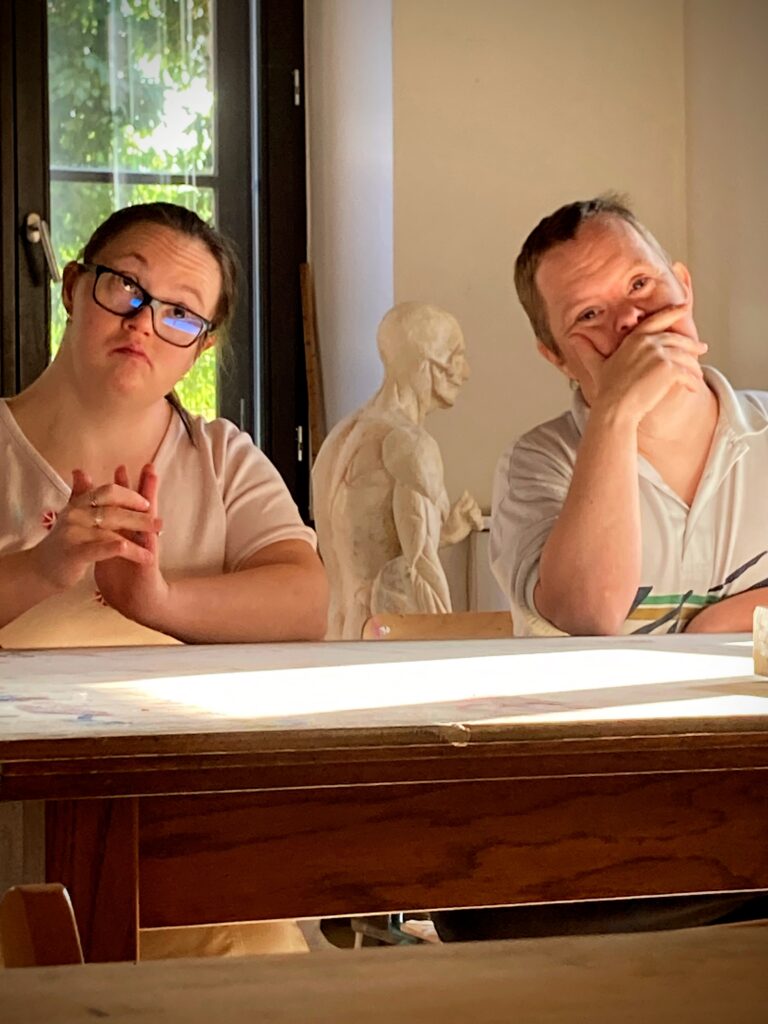
In September 2015, a joint project between the Fogd A Kezem Foundation and the Faculty of Arts of the University of Pécs was launched: a creative seminar series called “Art Brut,” in which the Foundation’s Youngsters living with intellectual disabilities create together with university students.
The initiative was realized with the support of the Ministry of Human Capacities and the National Disability and Social Policy Centre Public Benefit Nonprofit Ltd., within the framework of the successful grant project entitled “ART BRUT – Integrated Art at the Highest Level!” (see details below).
Since its launch, the seminars have been organized regularly semester after semester. During these sessions, creative groups of the Foundation’s Youngsters work together with painting and sculpture students from the University of Pécs under the guidance of the Faculty’s course leader and dr. Bence Zsin DLA to create paintings, drawings, and other artworks.
The aim of the program is to strengthen the values of openness, acceptance, and mutual care through art and shared community experiences. Beyond helping participants build relationships, the creative process also highlights the possibilities inherent in collaboration and opens a window into another world for both sides.
But what exactly is “Art Brut”?
The term, meaning “raw art,” can be traced back to Jean Dubuffetone of the defining French painters and sculptors of the 20th century. According to him, “official,” academic art had become overly regulated, elitist, and imitative, making it incapable of expressing genuine human experiences. This idea turned his attention toward groups living on the margins of society: he began observing and collecting works created by psychiatric patients, prisoners, and people living in difficult circumstances.
Although Dubuffet himself came from a wealthy bourgeois family and received academic artistic training, he became disillusioned with the world of classical artistic approaches already in the 1920s. He believed that conventions cause art to lose its spontaneity, sincerity, and authenticity.
When he returned to art in 1942 after a long hiatus, his style was already defined by a new way of thinking. Inspired by visits to Swiss psychiatric institutions, he began assembling a collection of works created by patients, and in 1948 he founded the “Compagnie de l’Art Brut” in order to promote research into the genre.
The Art Brut movement gradually gained increasing popularity. At first, the unconventional genre spread throughout Europe, and later it also influenced the American art scene. Unlike the dominant classical “isms” of the time, it was not confined to a unified style; instead, its aesthetic diversity was connected by the social positions of its creators.
The name itself is revealing: the rawness of the art lies in the fact that the creator expresses themselves instinctively; everything that takes shape within them is communicated without rules, in its original form. The genre therefore requires neither prior artistic knowledge or skills, nor prestige, status, or professional recognition – quite the opposite: here, those who are otherwise less heard by the world are given a voice..
„“The more banal something is, the better it suits me,” Dubuffet”, said in 1945.“Fortunately, I do not consider myself exceptional in any respect. In my paintings, I would like to bring back the perspective of an average, everyday person.”This mindset lies at the core of Dubuffet’s Art Brut style: leaving conventions behind in order to return honest human feelings and impressions to the canvas exactly as they are – sincerely and unfiltered.
Our Young Artists, Our Artist Youngsters
In Hungary as well, several Art Brut-inspired initiatives can be observed, whether in supporting the creative activities of psychiatric patients (e.g. Budapest Art Brut Galleryor in organizing artistic programs for people living with intellectual disabilities (e.g. the Autistic Art FoundationIn addition, creative development and art therapy activities are also present in the daytime care programs of numerous Hungarian support organizations.
Our Foundation can also be included among these initiatives, where our Youngsters have the opportunity to engage in community-based creative work in several different forms. In our therapy and work home, the Youngsters who spend their days with us participate in five workshops, including ceramics, creative arts, and candle-making workshops, where daily activities revolve around producing our products Beyond this, there are also regular opportunities for organized creative programs, ranging from art therapy sessions and photography exhibitions to collaborative painting events with elementary school students.
The Art Brut program realized together with the Faculty of Arts of the University of Pécs is one of these opportunities – and perhaps one of the most special among them: for our Youngsters, not only the creative process itself but also the location (the Zsolnay Cultural Quarter and the area around the Faculty), the presence of university students, and the entire program become a meaningful experience.
The jointly created works are often later exhibited; examples include the 2019 exhibition in Budapestthe 2023 exhibition entitled „Intertwining Worlds” held at the Kemence Gallery in the Zsolnay Cultural Quarter, and the 2024 exhibition „So That They May Truly See” opened at the Museum Gallery of the Janus Pannonius Museum.
The approach of Art Brut – both as a genre and as a seminar series – can therefore have a positive impact on people living with intellectual disabilities in several ways. It supports their integration into society, helps outsiders understand their perspective, thereby strengthening empathy and acceptance, while also showing that our differences are not disadvantages. That we may also look at these differences in another way: as something that brings us together and from which we can learn. Because when two different worlds meet on the canvas, the result can only be something truly special..
Project details:
Grant code: FOF2019/44
Title: ART BRUT – Integrated Art at the Highest Level!
Duration: 01.09.2019 – 08.10.2020
Amount: HUF 2,498,160